
Talon Contest Part 2: Clean-up Squad
Updated: Jan 30
Far too many people have negative impressions of vultures. If you describe somebody as a ‘vulture’ you are definitely not paying them a compliment. They clearly need better publicity as they are seriously undervalued and under-appreciated, yet play a critical role within an ecosystems rich in apex mammalian predators.

Africa is synonymous with vultures, but the truth is that they are in precipitous decline across the continent, primarly due to direct and indirect persecution through poisoning. Once ubiquitous, they have now become ever-more restricted to large protected areas and even here they are under pressure due to poaching for the nonsensical Chinese medicine market.
Kruger NP has suffered a number of mass mortality events due to poachers, but thankfully enough vultures remain to make any trip there worthwhile if they are on your list of target birds.
Early one morning, on our latest visit to Kruger, we discovered the corpse of a very recently deceased, heavily pregnant, Cape Buffalo Syncerus caffer at the side of the road. A small carnivore had chewed a bit at the nose and at its rear end. This was a natural death and no large carnivores had opened the carcass. Vultures were already gathering, presumably in anticipation of the arrival of hyenas or lions. Three days later, they were still waiting and by now over 100 vultures were gathered. Small inroads had been made on the entrance at the animal’s rear and some hungry vultures were battling over the opportunity to grab what they could through this narrow and rather unsavoury portal.

The whole spectacle was a sight, sound and smell overload. Much wing posturing, foot raising, hissing and beak jabbing was ongoing. The decaying corpse stank to high heaven, so it was surprising that no large predators had, as yet, visited the site. Patience is a virtue in vulture society.

The park hosts a number of different species, but by far the most numerous is the White-backed Vulture Gyps africanus. It can reach 98cm length and is a big heavy bird, the biggest topping out at over 7kg in weight. Nevertheless, this is noticeably smaller and lighter, than its close cousin the Eurasian Griffon Vulture Gyps fulvus.

It has a substantial bill, but it’s not powerful enough to tear the hide of most large mammals, as a result it specialises in consuming soft tissues, which pulls from an already opened carcass.

There are roughly 2000 pairs in Kruger and at a carcass they often act like mob, aggressively driving off other vultures, but there is also much in-fighting and it’s fascinating to watch the interactions between the birds.

After feeding they will be covered in blood, gore and worse and soon fly to a suitable bathing spot to get clean.
Cape Vulture Gyps coprotheres also occurs in Kruger, listed as Vulnerable internationally, its population is declining in Kruger, as elsewhere, as a result of deliberate poisoning. It’s much scarcer than White-backed Vulture, from which it is difficult to separate unless seen well. So far I’ve only recorded this species in flight distantly and haven’t been able to get any decent images worth showing in a blog. It will be one of my main targets on my next visit.

There is one vulture in Kruger with the tool to open an animal hide, the Lappet-faced Vulture Torgos tracheliotos. This is a huge bird, topping out at a maximum of 115cm and 8.5kg. it has a bill like a meat-cleaver. In Old World Vulture terms, only the European Cinerous (Black) Vulture Aegypius monachus, exceeds it in size.
In Kruger there are only some 160 mature adults. They often arrive late to a kill and don’t really assert themselves until some of the tougher body parts like sinews, cartilage and bone are exposed. When they do move in, the other vultures tend to part like the Red Sea.

Most people think that vultures only feed exclusively on carrion, but Lappet-faced Vulture is well known for directly predating a wide variety of animals from medium sized birds to young Impala Antelope.
That said, carrion remains their primary source of food and they are a key component of the ‘Clean-up squad’ in Kruger.

Probably the most dynamic vulture in Kruger is the White-headed Vulture Trigonoceps occipitalis. This species is critically endangered and is still in steep decline, loss of habitat and poisoning being the factors driving its rapid decent. South Africa contains fewer than 500 pairs and Kruger holds at least 250 mature adults, a huge proportion of the total and protecting the birds here will be pivotal in giving the species a chance to recover in Southern Africa as a whole.

This is a very unusual vulture. Pairs are territorial and stay within their territory all year. They are known to capture live prey and even hunt in tandem. Their binocular field of view is more akin to a hawk than a typical Gyps vulture. The other curiosity is that this species exhibits a significant degree of reversed sexual dimorphism. This again is a feature of active hunting hawks and eagles. Nevertheless, this bird does consume a significant proportion of carrion in its diet, indeed it is often the first vulture species to attend a kill.
From my personal observation I’ve never seen more than two White-headed Vultures attending a kill. Perhaps this is indicative of birds not straying much beyond their territorial boundaries?

The perched adult, with its white head, apparent black robes and ruff set against white undergarments are incredibly reminiscent of a barrister attending court at the Old Bailey. This is a truly remarkable bird in all senses of the word.
The final vulture covered here is the critically endangered Hooded Vulture Necrosyrtes monachus, with as few as 131,000 adults remaining worldwide. In South Africa there are believed to be between 50-100 breeding pairs. The latest estimate for Kruger is approximately 65 individuals.
They do have the reputation of being first, or at least one of the first, vultures at a kill site. This may be in part due to their habit of following hyena and wild dog packs.
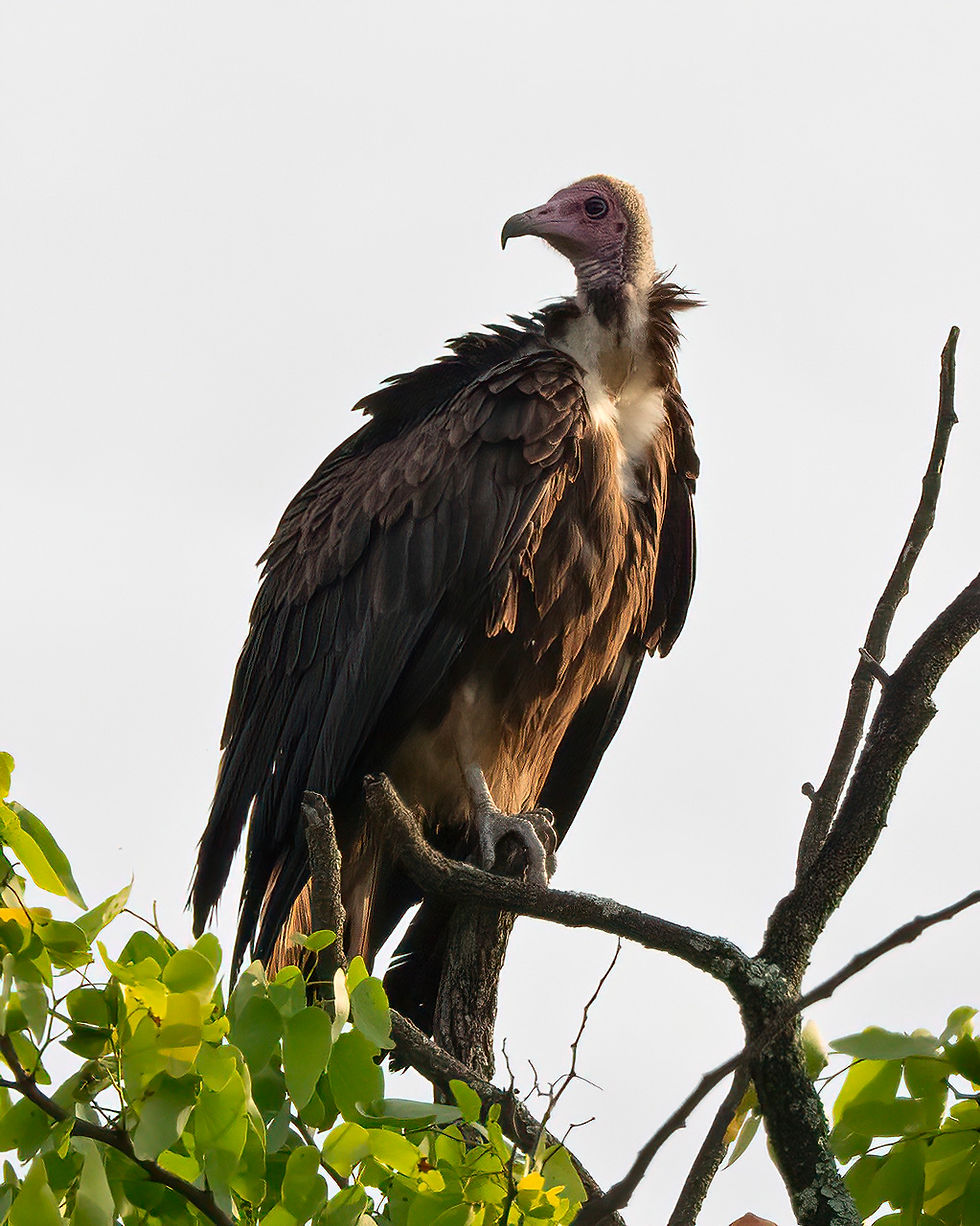
Except for small mammals, they are incapable of opening a carcass themselves. Even so carrion is their main food source. They generally let the larger vultures take their share and come in to pick at the remains. Their bill is well suited to winkling out the flesh between bones etc.

Apparently their grooved tongue also enables them to siphon off blood very effectively. In addition they also have a capacity for eating human waste. This is a resourceful member of the clean-up squad, hoovering up the last bits that others have missed.

Our final member of the Clean-up squad is not a vulture, but a stork, indeed the biggest stork of all. The massive Marabou Stork Leptoptilos crumenifer. It can reach a height of 152cm and a weight of 9kg.

The Marabou is sometimes nicknamed ‘The Undertaker’, though this is more associated with their garb than their habits. The take a lot of carrion in their diet, often following vultures and stealing discarded scraps or waiting till they have had their fill. They are however very varied in their diet. They will take fish, reptiles, mammals, a wide range of insects and they absolutely love to exploit human waste. Sometimes hundreds will gather at refuse dumps.

They are very odd looking birds, the bare head and neck an adaptation to feeding on and inside carcasses, and that strange pink pouch dangling from the neck is the source of the birds scientific name, which roughly translates as ‘carrying a purse around the neck’.
It is undeniable that the members of the ‘clean-up squad’ are not the beauties of the bird world, but they perform a critical function. We should appreciate them and ensure they have an environment in which they can continue to thrive.


Comments