
Talon Contest: Part 1. Eagles
In a diverse and fully-functioning ecosystem like Kruger National Park there are numerous ecological niches into which otherwise seemingly similar species can fit and thereby avoid continual direct competition. Where two species are in direct competition for the same resource and are trying to exploit it the same way, one species will dominate to the exclusion of the other. By differentiating, even slightly, the ways in which species can exploit limited food resources, it allows more diversity of species to exist in the same space.
Any visitor to Kruger NP, spending just a handful of days there, will encounter a wide array of avian predators, or at least those not blinkered into looking only for the ‘Big 5’. Spotting eagles and vultures is an everyday occurrence. There are plenty of smaller raptors, but they are less frequently observed simply because in Kruger, except in the rest camps and a small number of ‘safe’ get-out locations, you are confined to watching from your vehicle.

My most recent visit occurred in November and December 2025, following a similarly timed visit in 2022, at this time of year the eagle you most frequently encounter is Wahlberg’s Eagle Hieraaetus wahlbergi. This eagle is quite small, (maximum 61cm in length), rather variable in plumage, it has feathered legs, a small crest that is not always obvious, but a good identifier when you can see it. It also has a rather dainty bill. In flight the rather slender, square ended, tail can be a good identifying feature.
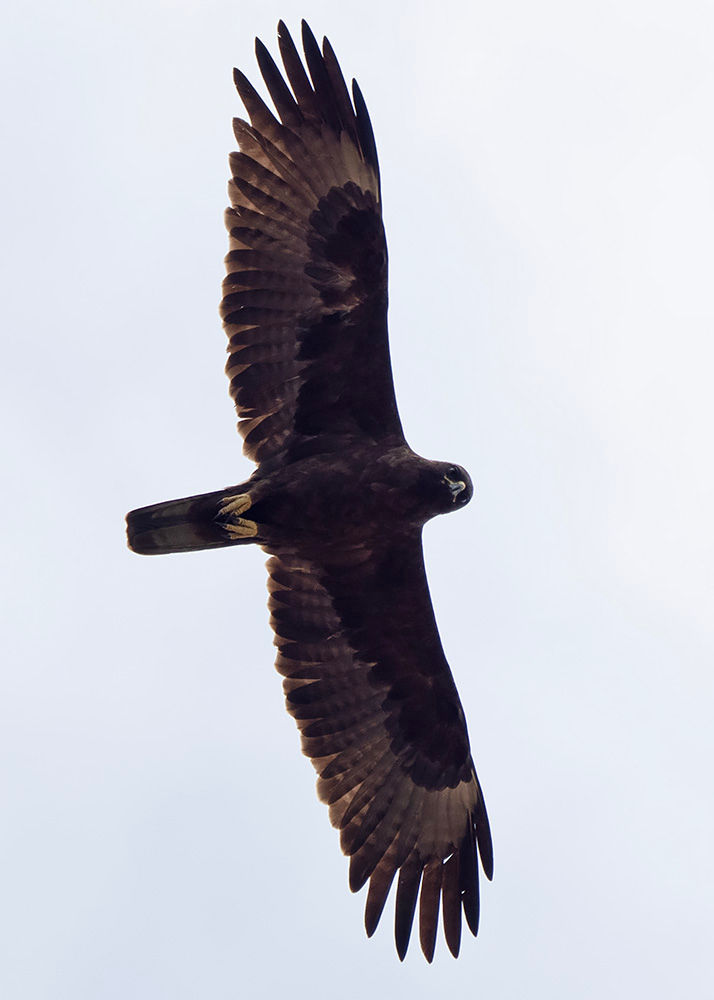
It is generally regarded as a bird predator specialist with larks, spurfowl, bustards and guineafowl forming a high proportion of its diverse avian prey. It also takes a smaller proportion of reptiles, small mammal and even seasonally abundant invertebrate prey in its diet. After an overnight emergence of flying termites, we witnessed a juvenile bird picking numerous stranded termites off a gravelled road shortly after sunrise.

African Hawk-Eagle Aquila spilogaster is a bulkier broader-winged bird topping out at 68cm in length. Adults are somewhat pale on the underside with a variably dark-streaked chest, younger birds are orange-chested, both have darker upperparts and feature a somewhat capped appearance. These are powerful birds and are typically seen hunting in pairs. Bonnelli’s Eagle Aquila fasciata is closely related and also exhibits this co-operative hunting strategy.

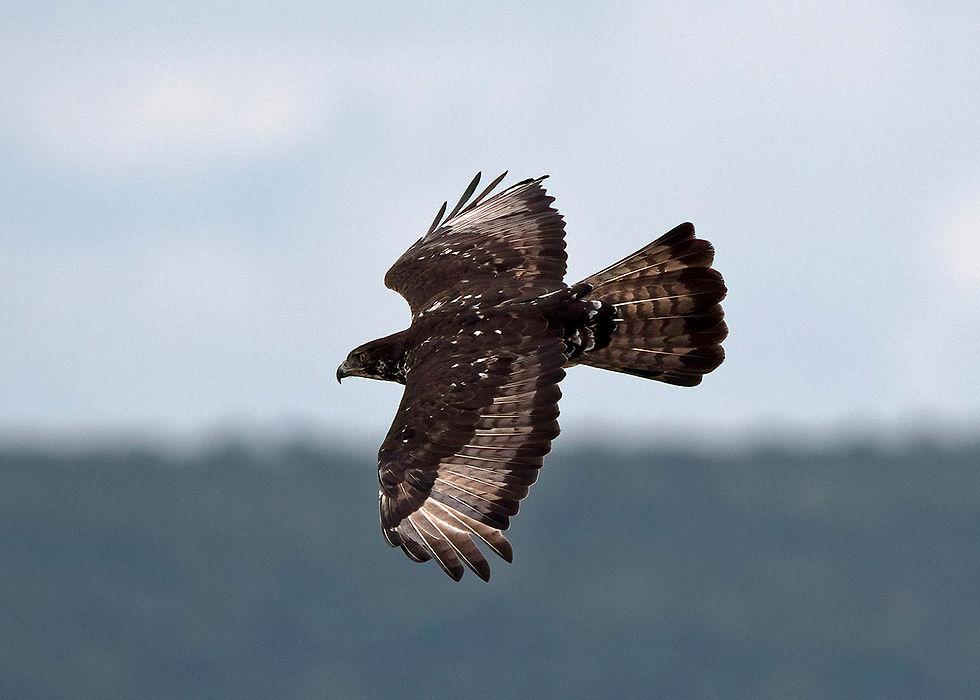
This species tends to perch in partial cover, from which it may launch attacks on birds like spurfowl and bustards, but it also takes a high proportion of larger reptiles. It will also scour large areas using thermals and wind. From a high vantage point over the Oliphant’s river I observed one pair employing ambush hunting, one of the pair flushing and driving the prey towards its mate. A clear demonstration that raptors are intelligent and capable of planned attacks, not dissimilar to a regular hunting strategy of lions.


If ever there was a raptor that epitomised Sub-Saharan Africa it is the spectacular Bateleur Terathopius ecaudatus. The name is French and means ‘street performer’, which, if you’ve ever seen one of these raptors in action, seems very apt.

A scan across the skies of Kruger will often reveal one or more of these birds patrolling with a characteristic wing rocking flight. When combined with the bird’s unique wing shape, proportionately long winged with bulging secondaries and a rather slender fingered primary projection and and improbably short tail, it renders this bird largely unmistakable. This is a medium sized raptor, topping out at 70cm in length but it gives the impression of being larger.

Recent genetic studies have confirmed, the long-held belief that this bird is a relative of the snake-eagles, but more surprisingly the Philippine Eagle. Like the snake-eagles it has unfeathered tarsi. This bird has an exceptionally long adolescence, only reaching full maturity at between 8 and 9 years of age. The juvenile’s gingery-brown plumage is somewhat uniform, but the adults are rather more colourful with a red face and legs being set against a combination of Black, tan and grey, together with contrasting white wing linings.

Even when perched these birds present a unique profile, a large, cowled, head and drooped primary feathers extending well-beyond the tip of the tail, especially on adults.
These are powerful birds capable of taking surprisingly large mammalian prey, they also take larger birds like spurfowl and large reptiles, but they are also adept at scavenging for carrion.

This bird has declined worryingly across Africa in recent decades and is now only readily found only in protected areas.
Kruger is home to actual snake eagles, namely Brown Snake Eagle Circaetus cinereus and the more strikingly marked Black-chested Snake Eagle Circaetus pectoralis.

Brown Snake-Eagle is a big, heavy, bird reaching up to 75cm, or more, in length and weighing upto 2.5kg. It mostly hunts from a perch and tends to prefer more undulating terrain, particularly where there are gullies and rocky slopes, staring down with its piercing yellow eyes in pursuit of, often very large, venomous snakes. With Puff Adders and Boomslangs being regulars on its menu. Snake-eagles as a group are noted for the exceptionally thick, tough, skin on their legs which affords them protection from snake bites. Other than snakes, it will also take large lizards and small mammals and even birds like francolins on occasion.

Its lighter and slighter congener, the Black-chested Snake-Eagle also takes a lot of venomous snakes as part of its preferred prey, but this bird takes a higher proportion of small mammals in its diet. It often hunts from a perch but will readily hover-hunt, like its close European relative the Short-toed Eagle, it was previously considered conspecific with that bird alongside, the Beaudouin's Snake-Eagle.

These days it is considered part of a superspecies (Collins Dictionary defines ‘superspecies’ as: a group of new species or subspecies that are different enough from other species to be considered an entity).
There are several species of Aquila eagle that frequent Kruger National Park, these eagles are the very definition of what an eagle supposedly looks like, regal, fierce expression and powerful. By far the commonest and most easily observed within the national park is the Tawny Eagle Aquila rapax.

This is a compact member of the Aquila tribe, topping out at 76cm in length. It looks remarkably similar to Steppe Eagle and the best way to separate the two, at least with perched birds, is to look closely at the gape. On Steppe Eagle the yellow skin reaches back to be level or past the back edge of the eye, on Tawny it just reaches a point level with the centre of the eye, a subtle but doable difference with decent views and especially if you can get decent images too.

On the most recent trip we had numerous superb encounters with Tawny Eagles, They frequently attend kills made by large mammalian predators and along with the vultures act as the clean-up squad. They need to be sharp and opportunistic to get their share, as they are dominated by the larger scavengers. We watched as one particularly aggressive juvenile attempted to fend off a White-headed Vulture at a lion kill, it no doubt learned a hard, but valuable, lesson as it got well and truly trampled by the vulture.

These eagles are adept at catching their own food. Pairs will engage in tandem hunting, and this is thought to enable them to secure larger prey items, including small antelope. They take a high proportion of mammals in their diet including Scrub Hare and even the nocturnal Spring Hare. They are also known to take mongoose species.

One of our closest encounters occurred when an adult Tawny Eagle called in a juvenilet to pass it a tree squirrel. Like an ungrateful teenager it snatched the squirrel and scowled at its parent aggressively.

Tawny Eagles also take a high proportion of large birds, with various species of Spurfowl and bustard featuring regularly in their diet.

The juveniles have a rather smart and neat buff plumage, adults vary a bit, but most have a rather mottled rich brown plumage that has a slightly looser structure than seen on the juveniles.
Of all the eagles in Kruger National Park, probably the one that defines the sound of Africa is the African Fish Eagle Icthyophaga vocifer. This is a truly iconic bird and it’s high pitched ringing yelps echo across the riverine landscape.
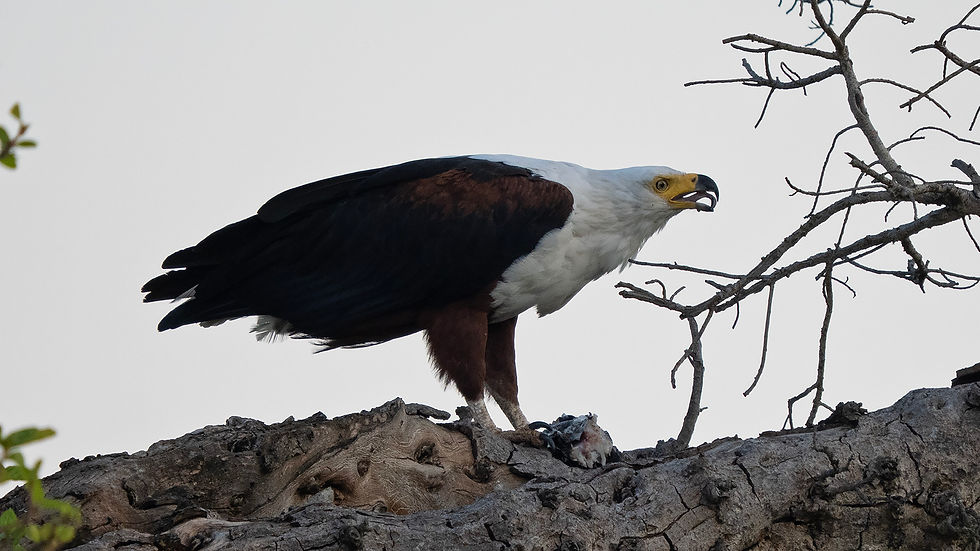
This is a big, bulky, bird. It was given it’s scientific name by the French naturalist Francois Levaillant, who called it ‘the vociferous one’.

Despite being strikingly white headed, as an adult, and being a true ‘fish eagle’ it is not particularly closely related to the American Bald Eagle Haliaeetus leucocephalus. The adults have a deep brown and chestnut plumage, excepting the white head, chest and tail and brilliant yellow facial skin at the base of the powerful beak, it also has unfeathered yellow legs. Juveniles start out streaky, blotchy brown, and take several years to acquire adult plumage.

As the name suggests it primarily feeds on fish, which it snatches from close to the surface. Sometimes the fish are so large it has to paddle to shore to dismantle its prey. It also practices kleptoparisitism, notably robbing ospreys and large wading birds like storks for their catch. It will freely take mammalian, bird and reptile prey and will even consume emerging termites.

In flight it has a very different form to any other eagle in the region. Huge, broad wings and a very short tail give it a unique profile.
The mighty Martial Eagle Polemaetus bellicosus is a truly huge bird, only matched in size, within Kruger NP, by the Verreaux’s (Black) Eagle, the very largest have been measured at 96cm and approaching 6.5kg in weight. It is thinly, but widely, distributed in Kruger NP.

This sub-Saharan species has been in precipitous decline due to persecution and is now endangered. It is increasingly confined to large, protected areas, like the national parks.
Adults have dark brownish upperparts and sparkling white underparts sparsely dotted with dark spots. The bird has a short but obvious crest. It also possesses the feathered legs typical of the ‘booted’ eagles.

Juveniles are considerably paler on the upperparts, having a frosted appearance but the pale underparts lack spots. They have huge feet and a large bill testament to the size of prey they typically tackle.

This species is renowned for its visual acuity, at least three times greater than a humans, meaning it can spot potential prey from at least 5km distance. It takes a wide range of bird, mammal and reptilian prey. It spends a lot of time soaring high. It varies the angle of its stoop depending upon the density of habitat. In Kruger Impala lambs and other small antelope form a significant proportion of its prey. Across their whole range they have been recorded preying on more than 30 species of ungulate and indeed it is considered a specialist predator of small antelope.
Any sighting of a Martial Eagle leaves a mark on your memory. They are truly magnificent and impressive birds.
This is by no means a comprehensive review of Krugers larger raptors, there are many species I haven’t even touched on, or in some cases even managed to lay eyes on. That’s for another day.
In part 2 I’ll cover the undertakers of Kruger.
All images are copyright of the photographer and may only be reproduced by permission.


Comments