
A Crown of Kingfishers
The Greeks considered Kingfishers to be born of the sea, hence the name Halcyon which translates as hals = sea and kyon = born. The mythology surrounding them has it that they could calm the sea during nesting. Calm periods to this day are often referred to as ‘Halcyon Days’.
As a north European naturalist my only regular contact with a member of the Kingfisher tribe comes courtesy of the Common Kingfisher Alcedo atthis, and like most kingfishers it is a colourful jewel of a bird, possessed of a proportionately large dagger bill, a very short tail, short legs and rather small feet. It also does as its name suggests, it almost exclusively eats fish, with only the occasional aquatic invertebrate and the odd newt for variety.

Depart Northern Europe and head towards the tropics and the diversity of Kingfishers explodes. At the time of writing there are 118 recognised species.
A recent visit to the Tropic of Capricorn straddling Kruger National Park, in South Africa provided multiple encounters with a wide array of Kingfishers, some of which rarely, if ever, eat fish.
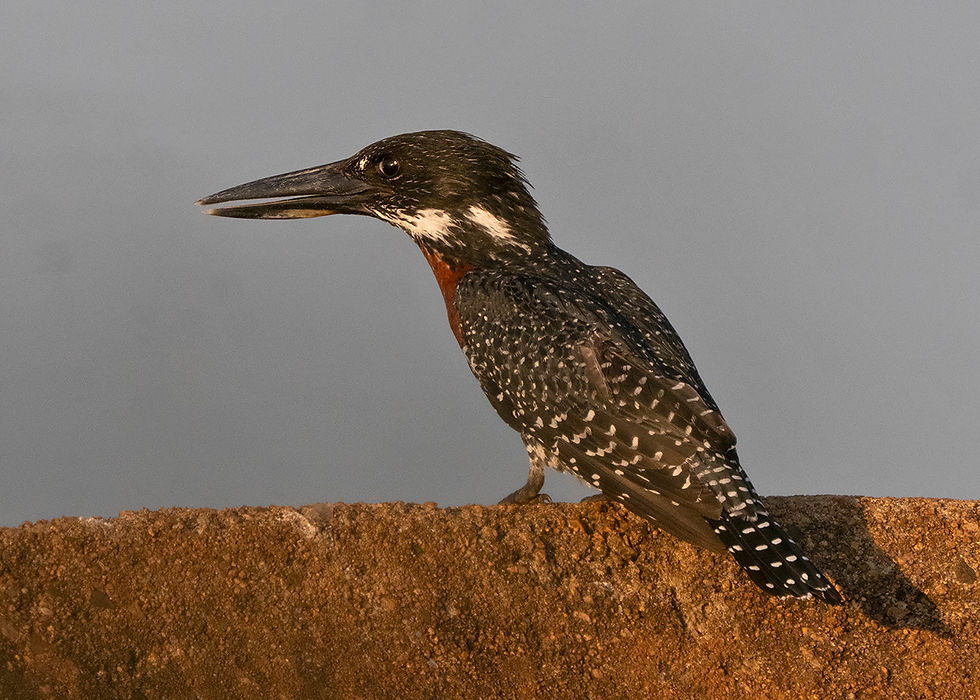
The Giant Kingfisher Megaceryle maxima is a colossus in kingfisher terms, topping out at 46cm in length, it is a heavy-billed bird and captures sizeable fish by plunge diving. It will also take amphibians and crabs. It has a rather floppy, bounding flight. Like many kingfisher species it burrows into vertical river banks, using its feet and bill. The tunnel can reach 2m in length ending in a nest chamber.
Step down a rung is size and another fish specialist hovers into view, in the form of he monochromatic Pied Kingfisher Ceryle rudis. At 25cm in length, it is still fairly large by kingfisher standards and it also happens to be one of the most obvious members of the family. It perches openly over water bodies and it also frequently hover-hunts before plunging diving after its preferred fish prey. Once captured a fish will be brought back to a favoured perch, where it is held at the tail end and repeatedly battered against the branch. It’s a bit like watching someone tenderise a steak, brutal but effective. The fish will then be manipulated and swallowed head-first.


Woodland Kingfisher Halcyon senegalensis rarely, if ever, eats fish, it’s a specialist invertebrate pouncer, though it also takes a proportion of small reptiles, amphibians and even small birds. At 23cm in length it is still a fair size. On my visits to Kruger it is one of the backdrop sounds of the National Park, it’s distinctive trilling song rings out across the more wooded sections of the park. You can listen to the sound here It is fiercely territorial and its chases and displays can be observed even in the heat of the day. This species doesn’t burrow into sandy banks, instead it utilises old woodpecker nest holes.

Brown-hooded Kingfisher Halcyon albiventris is only a centimetre shorter than the Woodland Kingfisher and its distribution closely matches that of its sister species, but there are critical differences in how they exploit food resources and habitats. This species tends to have a higher proportion of reptiles and small mammals in its diet. This is a bank burrowing species, so it isn’t competing with Woodland Kingfisher for nest sites. It’s another noisy bird. You can listen to its vocalisation on the ebird website page here.

During my most recent visit to Kruger I had the privilege of watching a pair of Malachite Kingfishers Corythornis cristatus excavating their burrow in a culvert bank. This is a small kingfisher, barely 13cm in length. At first glance it looks similar to the Common Kingfisher, but it is dainty in comparison to its 16cm cousin. It also possesses an all-orange bill, compared to the largely blackish bill of its congener. It has strikingly marked crown feathers banded with black and pale blue. These feathers are slightly elongated to form an erectable crest, which relates directly to its scientific name. The plumage of both sexes is similar. It plunge-dives after fish, but also takes a small proportion of invertebrates and crustaceans in its diet.


Our final rung on the ladder brings us down to the diminutive African Pygmy Kingfisher Ispidina picta. Just 12cm in length, it seems significantly smaller than the Malachite, which is only 1cm longer. (it is still not the smallest Kingfisher, that title belongs to the African Dwarf Kingfisher). This may have been the tiniest kingfisher I’d sighted and photographed in Kruger, but it probably gave me my biggest thrill. We found a pair at their nest burrow right next to one of Kruger’s numerous dirt roads. What an exquisite bird this is. Its cheeks are suffused with a delicate wash of pinky-mauve violet to differentiate it from the Malachite. The preferred food is a wide variety of small invertebrates including spiders. It is elusive, secretive and somewhat unobtrusive in its habits, so a close encounter is a rare privilege.

There are so many wonderful bird families in the world but, without doubt, Kingfishers will always rank highly in the most beloved and desired of birds, familiar to naturalists and the general public, their popularity is assured.


Comments