
Moving Day
Twice a year a pan-planetary urge grips a large proportion of the bird species of this world. The tilt of the earth’s axis in concert with the annual orbit of the sun creates a seasonal rhythm. Light sensitivity sets the clock and triggers a hormonal flood in preparation for the irresistible urge. Zugunruhe, a Germanic description of this ‘migratory restlessness’ perfectly encapsulates the state of readiness required to overcome the physical challenges of migration.
Migration is a deadly serious enterprise, only the fittest will complete the task. The threats are numerous: storms, predation, injury, habitat loss, a faulty internal compass, even glass-covered skyscrapers, can derail the attempt. The biggest danger is being young and inexperienced. A huge proportion of ‘first-timers’ don’t make it.

Witnessing bird migration can be both thrilling and humbling. The passing of nocturnal migrants goes largely undetected, most of us don’t have access to the finely tuned radar that reveals the echoes of the millions of beating wings, but with recent advances in modern acoustic recording devices, nocturnal migration monitoring (known as ‘nocmigging’) has opened a portal to these hitherto hidden journeys.
Thankfully many birds do complete much, if not all, of their migratory flights in the daylight hours. These diurnal migrants can become obvious to those attuned to the music of birds on the move. All of us have an innate capacity to absorb this sense of the world in motion, but modern life has turned most of our receptors to ‘off’. Having your senses switched to the ‘on’ position allows you to pick up the distinctive signature calls and flight styles of the multitude of species.
At the end of the first week of October, I had migrated to the Hebridean island of Islay, and stood at edge of the Atlantic Ocean. The wintering geese and swans, for which the island is justly famous, had still not arrived, held up in Iceland by storms and gales. We were almost out of time, before the weather finally relented and a window of opportunity opened for the birds to make the crossing.
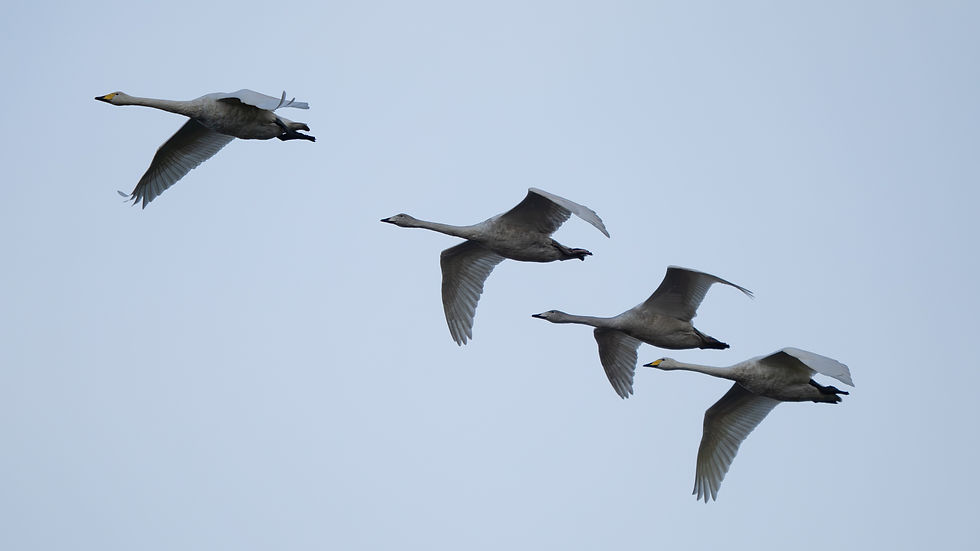
As the clocked ticked towards 10am a distant bugling carried on the wind. The unmistakeable sound of wild Whooper Swans on approach, over the blue water they came. They are fast flyers and with the wind at their backs they have been clocked at a ground speed of 101mph. These birds had the wind on their tail they whooshed over our heads, moments later they were gliding down to the freshwater loch behind us. Travelling at a height up to 27,000ft for over eight hours is a thirsty business.

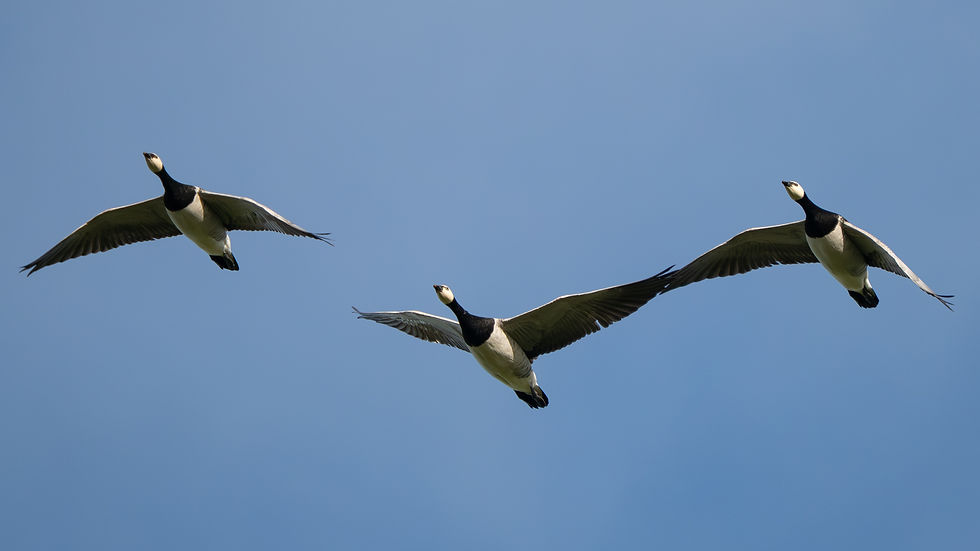
The geese have a slightly slower speed of flight but, by late morning, they too were winging their way into the receptive bowl of Loch Gruinart. These were Barnacle Geese arrived from their summer home of Greenland. By days end several hundred had made it to this critical RSPB refuge, the first of many thousands to arrive over the next couple of weeks.
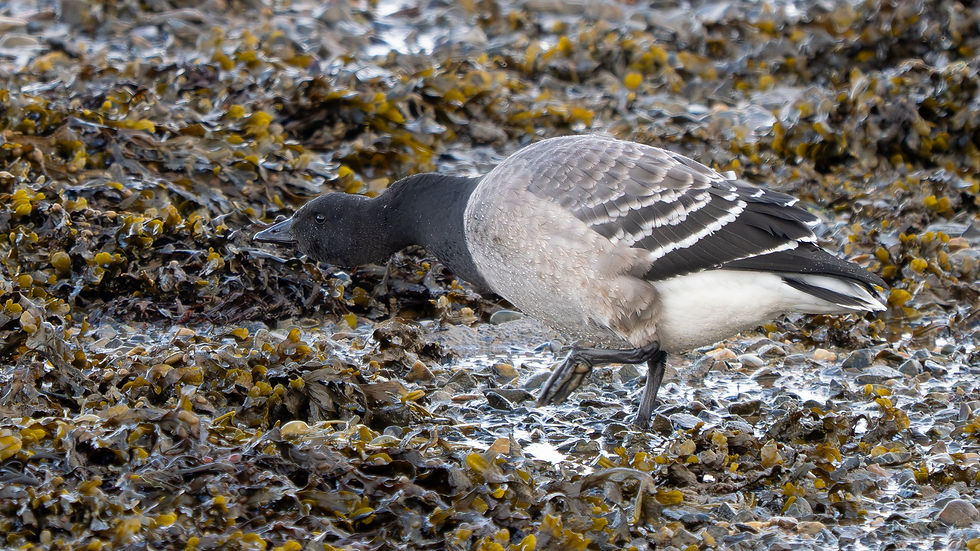
Along the shores of Loch Gruinart we also found a few Pale-bellied Brent Geese, fresh in from the Canadian Arctic. The common theme of all these species is that the young birds of the year are guided by their experienced parents. They learn their migratory routes, giving them a head start in completing the journey successfully.

Most birds, especially passerines, do not have this advantage. They are on their own, armed only with a basic compass and a rudimentary map, courtesy of celestial objects, together with a pre-set program to fly in a given direction for a specific period of time. With a fair wind they pitch down in roughly the right place. For many it is a flight into oblivion.
Early on the 30th September 2026, I approached Buckton Cliffs, part of Flamborough Head, tired Song Thrushes flushed off the grass path having pitched into the first patch of vegetation they encountered as they had cleared the cliffs. They had departed the Scandinavian coast for a flight lasting at least 12 hours under the cover of darkness, a useful strategy for avoiding avian predators. Now in full daylight they were exposed. The ever-watchful local Peregrine Falcons sensed their coming and would enjoy a hearty breakfast.
I stared out into the North Sea. With every scan of my binoculars, I would pick up a tiny dark dot, battling low across waves, heading toward the 300ft high cliffs, some would begin their climb several hundred metres from shore, timing their approach to breach the lip of the cliffs with precision. Others flew almost to the base of the cliffs, where the waves crashed against the limestone bulwark, before undertaking a rapid vertical ascent that would have made a Lightening Jet fighter-pilot envious.

For many of these birds it had clearly been a truly arduous journey, some were exhausted by the effort, only the fittest birds powered on inland, looking for more typical Song Thrush habitat. Judging by the number of clustered gulls, assiduously pecking at invisible objects on the surface of the sea, it was apparent that some had perished within sight of salvation. Success and failure for most migrating birds sits on a knife-edge and witnessing this spectacle makes you appreciate their tenuous grip on life.
The natural threats for migratory birds have always been present, however, today, human-made threats are taking an increasingly grim toll. Migratory birds are in steep decline. To ensure their survival we need to act now to reduce our impact. There are some simple cost-effective, even cost-saving, solutions that can genuinely help. All it requires is for governments to deliver and to have the courage to legislate for change.


Comments